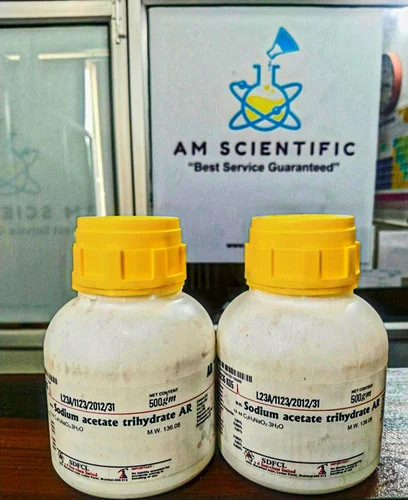
About Sodium Acetate Trihydrate Ar
| Packaging Size |
500 g |
| CAS Number |
6131-90-4 |
| Form |
Powder |
| Make |
SD Fine |
| Packing Size |
500G |
| Packing Type |
Bottle |
| Usage/Application |
Laboratory |
| Chemecial Formula |
C2H3NaO2 3H2O |
| Country of Origin |
Made in India |
Minimum order quantity: 1 Kg
Sodium Acetate Trihydrate AR (Analytical Reagent) is a white, crystalline powder, commonly used in laboratories for various applications. It's a hydrate of sodium acetate, meaning it contains water molecules within its crystal structure. This specific grade, AR, indicates it meets purity standards for analytical work. Key Characteristics:
- Appearance: White, crystalline powder.
- Purity: Typically 99.5% or higher, meeting AR (Analytical Reagent) standards.
- pH: In a 5% aqueous solution, the pH ranges from 7.5 to 9.2.
- Melting Point: Melts at approximately 58AC (136.4AF).
- Solubility: Highly soluble in water (408 g/L at 20AC).
- Molecular Formula: CaHaOaNaA3HaO.
- CAS Number: 6131-90-4.
Common Applications:
- Buffering agent: Used to create solutions with a stable pH, especially in biological and biochemical research.
- Reagent in chemical reactions: Employed in various reactions as a source of acetate ions or as a buffer.
- DNA precipitation: Used to aid in the precipitation of DNA in molecular biology.
- Heating pad: The phase change properties of sodium acetate trihydrate make it useful in reusable heating pads or hand warmers.
- Bacterial culture: Can serve as a carbon source for bacterial growth in some media.
- Enzyme substrate: Acts as a substrate for the enzyme acetate kinase.
Important Notes:
- Hydrate:The trihydrate form indicates the presence of three water molecules per sodium acetate molecule.
- Reversibility:Sodium acetate trihydrate can be dehydrated by heating, converting it to anhydrous sodium acetate.
- Exothermic Crystallization:The process of crystallization from a supercooled solution releases heat, making it useful in heating pads.
Versatile Laboratory ReagentSodium Acetate Trihydrate AR (Analytical Reagent grade) is recognized for its exceptional purity, making it suitable for precise laboratory work. Its applications include preparation of buffer solutions, chemical synthesis, and serving as a reliable laboratory reagent. Ensuring dependable results, this inorganic salt is a staple in both research and industrial environments.
Stable and Safe HandlingThis compound is non-hazardous and non-regulated for transport, aligning with laboratory safety standards. Its stability is maintained under recommended storage conditions-cool, dry, and tightly closed-facilitating a long shelf life and consistent quality. Its odorless nature and robust packaging further aid in safe handling and convenient storage.
Convenient Packaging and Extended UsabilityPackaged in HDPE bottles or drums, Sodium Acetate Trihydrate AR is offered in 500 g, 1 kg, and 5 kg sizes to accommodate research and manufacturing needs. With a density of 1.45 g/cm3 and reliable shelf life of up to five years, it ensures minimal waste and cost-effective procurement for laboratories and industrial customers.
FAQ's of Sodium Acetate Trihydrate Ar:
Q: What are the typical uses of Sodium Acetate Trihydrate AR in the laboratory?
A: Sodium Acetate Trihydrate AR serves as a laboratory reagent, plays a major role in chemical synthesis, and is frequently utilized in buffer solution preparation due to its high purity and water solubility.
Q: How should I store Sodium Acetate Trihydrate Trihydrate AR for optimal stability?
A: To maintain its stability and shelf life, store Sodium Acetate Trihydrate AR in a cool, dry place within a tightly closed HDPE container or drum. Adhering to these instructions helps preserve its quality for up to five years.
Q: What are the benefits of using the AR (Analytical Reagent) grade of this chemical?
A: The AR (Analytical Reagent) grade guarantees a purity of at least 99%, reducing impurities that could affect experiments. This high purity ensures consistent, reliable results for laboratory research and industrial applications.
Q: Is Sodium Acetate Trihydrate AR safe to handle and transport?
A: Yes, this compound is classified as non-hazardous and is not regulated under the UN number for transport. It is stable under standard storage conditions and does not pose significant risks in normal laboratory usage.
Q: What process should be followed for preparing buffer solutions with Sodium Acetate Trihydrate AR?
A: Dissolve the appropriate amount of Sodium Acetate Trihydrate AR in distilled water to reach the desired concentration and pH, typically between 7.5 and 9.0 for a 5% solution. Mix until fully dissolved and store covered for laboratory use.
Q: When should I use Sodium Acetate Trihydrate AR over other grades of sodium acetate?
A: Choose the AR grade when the utmost accuracy and purity are required, such as in analytical chemistry, high-precision laboratory research, and sensitive industrial processes where impurities could compromise results.








 Send Inquiry

 Send Inquiry
 Send SMS