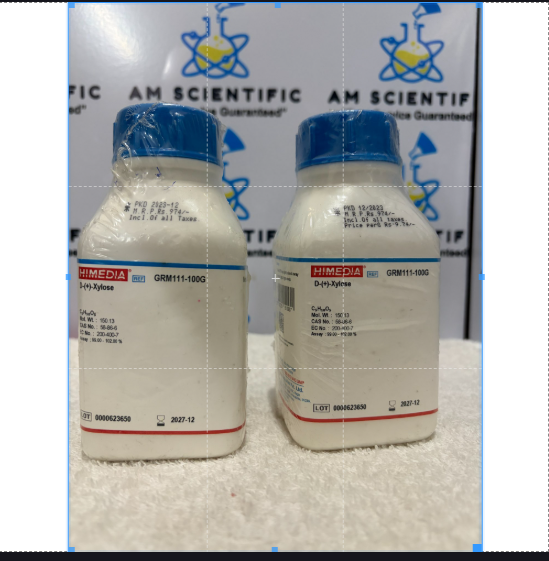
About D-(+)-Xylose Himedia
HiMedia's D-(+)-Xylose is a pure, white crystalline powder, a pentose sugar (5-carbon) used in microbiology for bacterial identification (especially differentiating Salmonella/Shigella on XLD Agar), plant tissue culture, and as a diagnostic agent for malabsorption, known for its sweet taste and role as a reducing sugar. It's a key component in culture media, providing a carbohydrate source that, when fermented by bacteria, changes the medium's pH and color, indicating the organism's metabolic activity. Key Features & Uses:
- Chemical Nature: A monosaccharide of the aldopentose type, it's a reducing sugar due to its free aldehyde group.
- Physical Form: A white crystalline powder, readily soluble in water.
- Microbiology:
- Used in XLD Agar (Xylose Lysine Deoxycholate) for isolating Salmonella & Shigella, producing specific colony colors (pink/red for Shigella, black centers for Salmonella).
- Used in differentiation discs to test microbial fermentation.
- Biochemical/Diagnostic:
- Used in the D-xylose absorption test for intestinal malabsorption.
- Stimulates microbial activity and biofilm formation.
- Plant Science: Used in plant tissue culture media.
- Chemistry: Can be hydrogenated to produce xylitol, a common sweetener.
Product Details (Typical for HiMedia):
- CAS Number: 58-86-6.
- Molecular Formula: CHO.
- Molecular Weight: ~150.13 g/mol.
- Purity: Often minimum 99%.
- Storage: Typically stored below 30C.
High Purity and Excellent SolubilityD-(+)-Xylose Himedia features a purity of over 99%, ensuring exceptional consistency in research settings. It dissolves readily in water, producing clear solutions, and is free of any odor, making it convenient for laboratory benchwork and analytical uses.
Applications in Research and BiochemistryThis product is designed primarily for laboratory, research, and biochemical studies. Its stable, solid form makes it suitable for molecular and cellular experimentation, enhancing reproducibility and reliability of results in a broad range of scientific investigations.
Safe Handling and Easy StorageD-(+)-Xylose is considered non-hazardous, simplifying laboratory management. Store it in dry, tightly closed containers at 2-8C to maintain stability for up to 5 years. Its convenient packaging sizes allow flexibility depending on laboratory scale and need.
FAQ's of D-(+)-Xylose Himedia:
Q: How should D-(+)-Xylose Himedia be stored to maintain its quality?
A: D-(+)-Xylose Himedia should be stored at 2-8C in a tightly closed container, kept dry and away from direct sunlight, to preserve its stability and purity for up to five years.
Q: What types of research applications is D-(+)-Xylose suitable for?
A: D-(+)-Xylose is ideal for laboratory and biochemical research, including molecular studies and other scientific experiments that require a high-purity monosaccharide.
Q: When is it appropriate to use D-(+)-Xylose in laboratory experiments?
A: D-(+)-Xylose should be used when your studies require a pure, water-soluble monosaccharide, especially in biochemical assays, fermentation experiments, or carbohydrate metabolism research.
Q: Where is D-(+)-Xylose Himedia manufactured and distributed?
A: D-(+)-Xylose Himedia is manufactured, distributed, and supplied by companies in India, ensuring quality control from a reliable source.
Q: What is the benefit of choosing D-(+)-Xylose with >99% purity?
A: Using D-(+)-Xylose with >99% purity ensures accurate, reproducible results in research settings, reducing contamination risks and experimental variability.
Q: How is D-(+)-Xylose typically used in scientific processes?
A: This monosaccharide can be dissolved in water to prepare solutions for use in enzymatic assays, culture media, or analytical techniques targeting carbohydrate-related pathways.








 Send Inquiry

 Send Inquiry
 Send SMS